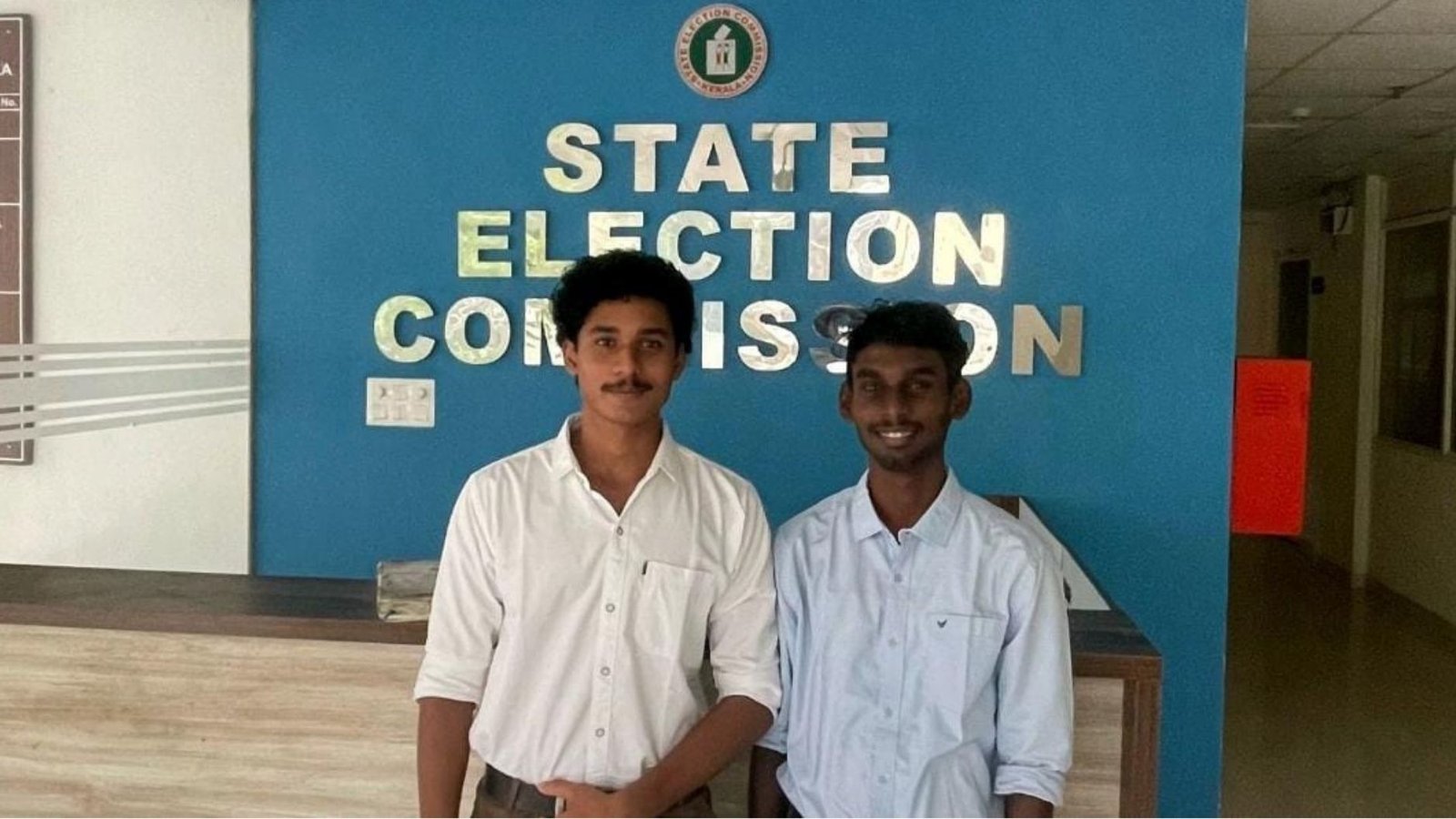
When Kerala goes to local body elections this December, two young first-time voters will be watching the process more closely than anyone else because the State Election Commission, Kerala (SEC) will be using a software developed by them to track the EVM data.
Jeswin Sunsi from Kodakara, Thrissur, and his best friend Aashin C. Anil from Thiruvananthapuram, both third year BTech Computer Science students at SRM Institute of Science and Technology, Chennai, have spent the past six months developing EVM Track, a comprehensive inventory and lifecycle management system for Electronic Voting Machines (EVMs).
For Jeswin, the experience is still sinking in. “It’s surreal. This is the first time a software I’ve developed will be used by so many government officials,” he says. “In the larger picture it’s a minute cog but it’ll always be one of my biggest contribution,” he added.
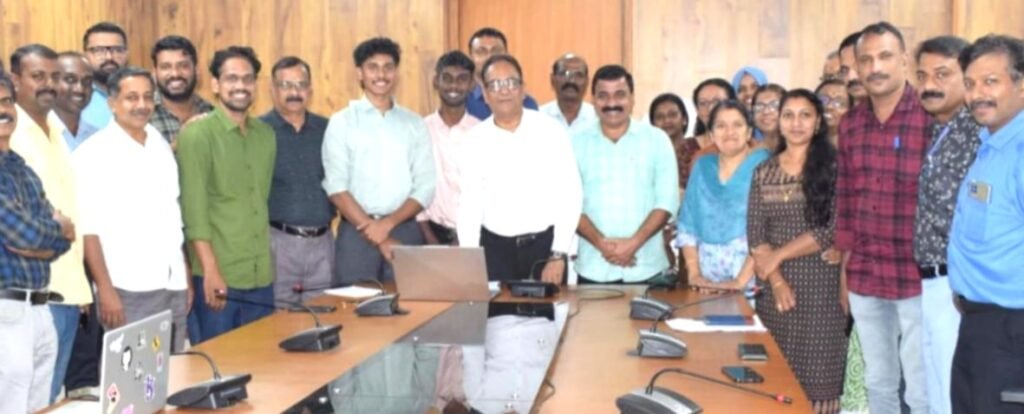
Both students will be casting their very first votes in this election. “I feel more responsible for my society now,” Jeswin adds. “Knowing that we helped increase transparency makes the process even more meaningful.”
An EVM isn’t one device it’s a collection of components the Control Unit (CU), Ballot Unit (BU), DMM (Display & Monitoring Module), plus various seals, each with unique serial numbers. Across Kerala, there are nearly two lakh individual components, and an equal number of seals numbers that double with every election cycle.
“Earlier, everything was written manually on paper. Tracking where a component was, who handled it last, when it was paired, or finding reserve machines everything took time, effort, and repeated rewriting. Our software has made the tracking easy and convenient for the SEC,” Jeswin explains.
The platform provides a single point control for the SEC, enabling automated tracking of allotment, movement, replacement, FLC (First Level Checking), commissioning, and reservation. Every detail that once lived in handwritten logbooks is now digital, traceable, and accessible.
The project began when EVM consultant L. Suryanarayanan approached the duo with the idea. The students built a prototype in just two weeks, which the SEC approved for further development.
What followed were six months of relentless coding, design, testing, and deployment all carried out by the two students themselves while juggling college demands.
Teamwork played a crucial role in our success. “There was always an understanding between us. Decisions were easy. Tasks divided naturally.”
“To balance classes and the project, some days we had to work late night” Jeswin recalled.
Aashin worked on database modelling while Jeswin worked on server deployment. “We never had rigid roles we communicated easily and split tasks smoothly,” he added. The software underwent performance testing and a rigorous security audit by the Standardisation, Testing & Quality Certification Directorate (STQC), a requirement for public election applications.
One of the most difficult challenges while working on the system was designing a secure data flow for the EVM.
“Each EVM travels from the SEC to district, block and panchayat levels. During this journey, seals are added and removed and components are paired. A false pairing or a misplaced seal can compromise the system. Modelling this safely was extremely challenging,” Jeswin explains.
Having now contributed to one of Kerala’s most sensitive public processes, both students say they’re keen to work on more government projects.
“This project showed us how technology can strengthen public systems. We would love to keep contributing,” Jeswin added. The Kerala local body elections are being held in two phases: the first on December 9, 2025, and the second on December 11, 2025. The results will be declared on December 13, 2025.